Eastern subterranean termites build underground nests in the damp red clay of Wake County and forage upward into load-bearing sills, floor joists, and subfloors. In historic neighborhoods like Mordecai, Oakwood, and…
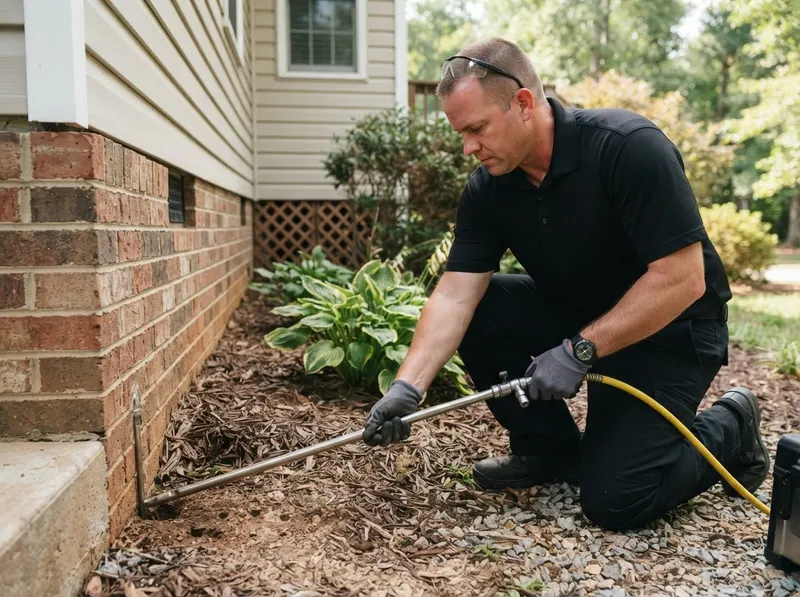
Eastern subterranean termites build underground nests in the damp red clay of Wake County and forage upward into load-bearing sills, floor joists, and subfloors. In historic neighborhoods like Mordecai, Oakwood, and Boylan Heights, older crawlspaces with native soil floors and low clearance offer direct mud tube routes from ground to structural pine. Modern monolithic slab homes throughout Brier Creek and Wakefield face an alternate vulnerability: hairline settlement gaps and bath trap slab cutouts where termites bypass exterior perimeters entirely. Surface barrier spraying fails because worker termites detect simple repellent chemicals and navigate around thin surface films. Comprehensive soil remediation introduces an undetectable, non-repellent liquid active ingredient, binding directly to clay soil particles at a depth of 6 inches into trenches and down to footing levels via sub-surface rod injection.
A complete soil remediation fits residential properties showing active shelter tubes, damaged sill plates, or heavy spring swarms within 50 feet of the foundation. In contrast, standalone bait stations fit situations where hardscaping, decorative flagstone patios, or interior masonry encasements prevent physical soil access. The trade-off is mechanical certainty versus monitoring speed: a liquid soil remediation creates an immediate, continuous treated zone around the exact load-bearing footprint, whereas bait systems rely entirely on foraging workers discovering monitoring stations over an extended 30 to 90-day window. If foundation footings in North Hills or Glenwood South rest adjacent to heavy clay grading that traps roof runoff, liquid trenching provides stable chemical binding that remains immobile in soil once set.
Executing soil remediation requires precise physical labor to achieve proper chemical saturation. First, a continuous trench measuring 6 inches wide by 6 inches deep is excavated against exterior masonry foundation walls and around interior crawlspace brick piers. Second, non-repellent termiticide is applied at a verified label rate of 4 finished gallons per 10 linear feet per foot of depth, saturating the backfill soil as it is replaced. Third, attached concrete garage slabs, front porches, and Village District patio slabs are drilled vertically through the masonry every 12 inches using carbide-tipped hammer drills to inject termiticide directly beneath the concrete pad. Fourth, internal plumbing penetrations inside crawlspaces are treated via targeted sub-surface soil saturation to prevent termites from trailing condensation lines into interior partition walls.
Every job gets a firm, written price after a free on-site visit.
Tell us about your subterranean termite soil remediation job in Raleigh and we'll send a clear, written quote, usually the same day.
 Carolina Fox Pest Control